

You must have heard the word blockchain on news channels. Maybe someone told you about Bitcoin and said blockchain is something very difficult. Maybe you felt that this is only for computer people. That is not true. You do not need to know coding to understand what is blockchain technology. You do not need to be a engineer. You just need a simple way of thinking.
In this article, I will answer what is blockchain technology in the easiest way. I will give you blockchain technology explained without any hard words. You will learn blockchain basics that even a school student can understand. I will show you how blockchain works using a real life example from India. This is blockchain technology for beginners written by keeping you in mind. After reading this, you will be able to explain what is blockchain technology to your family members.
What Is Blockchain Technology with Example in Simple Words
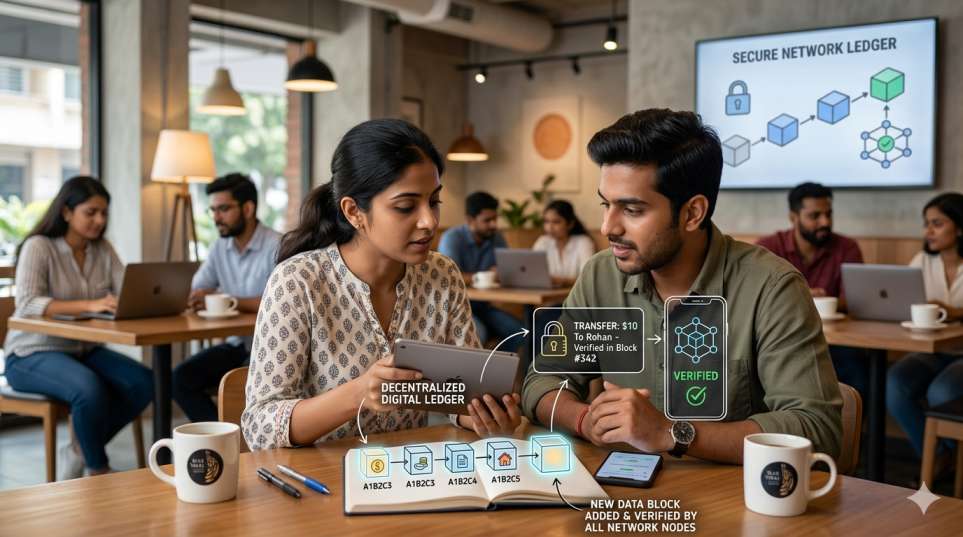
The best way to understand what is blockchain technology with example is to forget computers for some time. Think about a small coconut shop in Chennai. The shopkeeper has a notebook. In that notebook, he writes down every coconut he sells. He writes the date, the time, and how many coconuts. This notebook is his record.
Now think about a problem. What if the shopkeeper makes a mistake? What if someone forces him to change an old page? What if the notebook gets lost in rain? These are real problems with normal record keeping.
Now imagine a different system. Ten different shops in the same street all have the same notebook. Every time any shop sells a coconut, all ten shops write the same thing in their notebook. And before writing, they all check with each other that the information is correct. Once everyone writes, nobody can erase that page. If one shop tries to change old writing, the other nine shops will say no because their books still have the old writing.
You may also read :- Types of Blockchain Technology Explained: Public, Private, and Hybrid
Blockchain Technology Explained: The Three Simple Parts
When we say blockchain technology explained, we need to understand three simple parts. No hard words. Just three ideas.
Part One: The Block
A block is like one page of a register. On that page, some information is written. In the case of money, the block will say who sent money, who received money, how much money, and at what time. In the case of land records, the block will say which land, which owner, and which date of transfer. Every block has a limit. Once the page is full, a new page is made.
Part Two: The Chain
When one block is full, it is connected to the previous block. How is it connected? The new block carries a small signature from the old block. Think of it like this. You write a letter. Before sealing it, you make a copy of the last line of the previous letter and write it on top of the new letter. Then you seal it. Now anyone who sees your new letter can see it is connected to the old letter. This linking is the chain. That is why it is called blockchain.
Part Three: The Network
The network means all the computers that keep the same blocks. There is no single computer in charge. Every computer has the same full copy. When someone wants to add a new block, all computers check it together. If most computers agree that the information is correct, only then the new block is added.
How Does Blockchain Technology Work Step by Step?
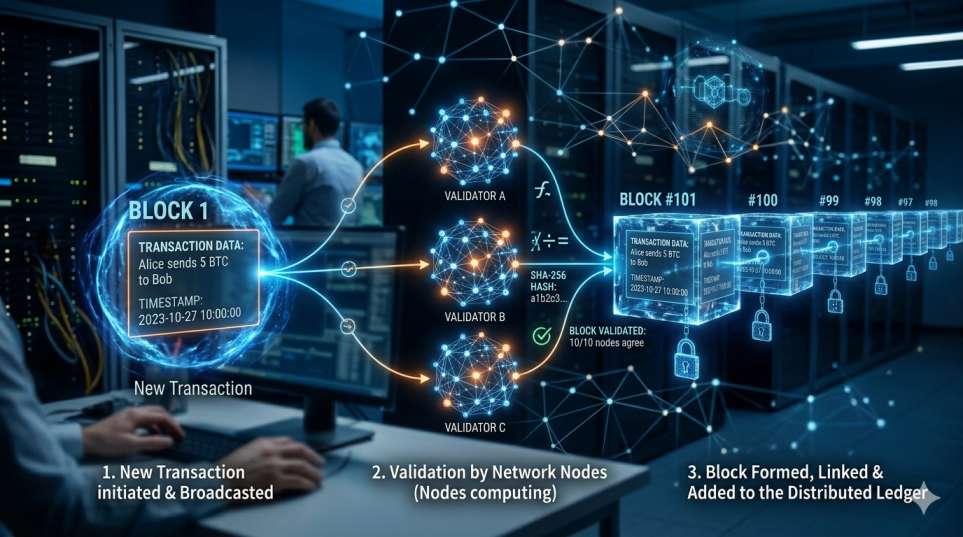
Now I will answer your long-tail keyword. How does blockchain technology work step by step? I will give you five clear steps. No confusion.
Step One: Someone Starts a Transaction
A person wants to do something. Send money. Register a land sale. Record a exam certificate. Whatever it is, that person creates a request. This request is sent to the network of computers.
Step Two: The Request Goes to Many Computers
The request does not go to one computer. It goes to all computers in the network at the same time. In our coconut shop example, when one shop sells a coconut, all ten shops get the news together.
Step Three: Computers Check the Request
Every computer in the network checks if the request is correct. They see if the person has enough money. They see if the land actually belongs to that person. They see if the signature is real. Each computer does this checking on its own.
Step Four: Computers Agree
After checking, each computer says yes or no. If most computers say yes, then the request is approved. This agreement is called consensus. No single computer can force a yes. The group decides.
Step Five: A New Block Is Created and Added
After approval, the transaction is written in a new block. This new block carries the signature of the previous block. Then it is added to the chain. Once added, no one can change it. Not even the person who started the request.
Why Is Blockchain Important?
Now let me answer why is blockchain important. This is a very good question because many people ask why we need this new system at all. Normal record keeping has three big problems. First problem is trust. When you send money through a bank, you are trusting that bank will not cheat you.
When you register a land paper with the government office, you are trusting that officer will not change the record. Second problem is cost. Banks and offices charge fees. Third problem is time. Bank transfers can take two days. Land registration can take two months.
Blockchain solves these three problems. You do not need to trust any one person because you are trusting the system of many computers. There is no single person who can cheat. The cost is very low because there is no middleman taking commission. And the speed is fast because computers work 24 hours without holiday. Even Sunday. Even midnight.
What Are the Benefits of Blockchain Technology?

Let me list the main benefits. I will keep each point short and clear.
Benefit One: No Single Owner
No person, no company, no government owns the blockchain. It is owned by all computers together. So nobody can shut it down. Nobody can say I am changing the rules.
Benefit Two: Nothing Can Be Deleted
Once something is written on a blockchain, it is written forever. You cannot go back and erase it. You cannot change it. You can only add new information. This is very useful for records like degrees, medical reports, property papers.
Benefit Three: Everyone Can See
In most blockchains, anyone can see the transactions. Not your name, but the activity. This openness means nobody can hide cheating. If someone tries to do something wrong, everyone will see.
Benefit Four: Very Safe
To change one block, a person would need to change that block on most computers at the same time. That is almost impossible. It would take so much electricity and so many computers that it is not worth it. So blockchain is very safe.
Benefit Five: No Downtime
Blockchain never sleeps. It does not close on Sunday. It does not close for lunch. It works every second of every day. You can send money or record something at 2 AM also. These are the main what are the benefits of blockchain technology. Now you can see why so many people are excited about it.
Where Can Blockchain Be Used in India?
Let me give you some Indian examples so blockchain technology for beginners becomes more real.
Land Records: Many people in India fight over land. Papers are lost. Officers change records for money. If land records are kept on a blockchain, nobody can change them secretly. Every change is seen by everyone.
Educational Certificates: Fake degrees are a big problem. If a college puts your degree on a blockchain, any employer can check if it is real. The employer does not need to call the college. They can check instantly.
Medicine Supply: Fake medicines are sold in many places. If every medicine box has a blockchain record from factory to shop, you can check if your medicine is real before buying.
Money Transfer from City to Village: When you send money from Delhi to your village in Bihar, it goes through many banks. Each bank takes a small cut. Blockchain allows direct sending with very little cut. The money reaches faster.
These are real uses. This is not future talk. Some of these are already happening in India.
Common Doubts That Come to Mind
I know you still have some questions. Let me answer a few common ones.
Is blockchain same as Bitcoin?
No. Bitcoin is a digital money. Blockchain is the record keeping system that Bitcoin uses. Bitcoin is one application of blockchain. Just like email is one application of the internet. But the internet is bigger than email.
Do I need to learn coding to use blockchain?
No. You do not need to learn coding to use blockchain. Just like you do not need to learn how a engine works to drive a car. The people who build blockchain need coding. You only need to use applications that run on blockchain.
Can blockchain be hacked?
In theory, everything can be hacked. But in practice, hacking a big blockchain is very very hard. It would take more money than what you would gain from hacking. That is why people trust it.
Will blockchain remove all bank jobs?
No. Blockchain will change how banks work. But it will not remove banks completely. Banks will also start using blockchain to do their work faster and cheaper.
Final Words: What You Should Do Now
You have now learned what is blockchain technology. You have seen blockchain technology explained without any hard words. You know blockchain basics. You understand how blockchain works step by step. You have read blockchain technology for beginners in a way that makes sense. You also know what is blockchain technology with example. And you can explain how does blockchain technology work step by step to someone else. You also know why is blockchain important and what are the benefits of blockchain technology.
Do not try to understand everything in one day. Read this article again tomorrow. The second time, the ideas will feel more familiar. Blockchain is a new way of thinking. It takes some time for the mind to accept it. That is okay.
If someone asks you what is blockchain technology, do not give a long speech. Just say this. A blockchain is a shared notebook that nobody can erase from. Many people keep the same notebook. And every new page is tied to the old page. That is all.