

The Nifty Next 50 index is one of the most exciting segments of the Indian stock market. It represents the potential blue-chip companies of tomorrow. If you want to grow your wealth by investing in large companies that still have high growth room, this is the place to look.
In this guide, we will explore the Best Nifty Next 50 ETF in India 2026. We will also compare them with index funds and the Nifty 50 to help you make a smart choice for your money.
What is the Nifty Next 50 Index?
The Nifty Next 50 index consists of 50 companies from the Nifty 100. These are the companies that come right after the top 50 (Nifty 50) in terms of size. People often call this index the "Junior Nifty."
Investing here means you are betting on companies that are already large and stable but are not yet in the top 50. Many of these companies eventually move up into the Nifty 50 as they grow bigger.
You may also read :- NFT Guide for Beginners: Everything You Need to Know Before Buying
Next 50 Index Constituents
The list of stocks in this index changes every six months. As of early 2026, the index includes leaders from various sectors. Some well-known names often found here include:
- Hindustan Aeronautics (HAL)
- Avenue Supermarts (DMart)
- Adani Power
- Hindustan Zinc
These companies are spread across sectors like Financial Services, Consumer Goods, and Healthcare. This variety helps protect your money if one sector performs poorly.
Best Nifty Next 50 ETF in India 2026
When choosing an ETF (Exchange Traded Fund), you should look at three things: Liquidity, Expense Ratio, and Tracking Error.
Here are the top-performing Nifty Next 50 ETFs in India for 2026:
1. Nippon India ETF Nifty Next 50 Junior BeES
This is the oldest and most popular ETF in this category. It is highly liquid, which means you can buy or sell large amounts easily on the stock exchange. It remains a top choice for both small and large investors.
2. Kotak Nifty Next 50 ETF
Kotak’s offering is known for having a very low expense ratio. This means the fund house takes a smaller fee, leaving more profit for you. It has shown steady performance over the last few years.
3. UTI Nifty Next 50 ETF
UTI is a trusted name in the Indian market. Their ETF is known for its low tracking error. This means the fund does a great job of following the actual index closely without much difference in returns.
4. ICICI Prudential Nifty Next 50 ETF
This ETF is another strong player with high trading volumes. It is suitable for investors who want a reliable fund from a large private bank.
Nifty Next 50 vs Nifty 50: Which is Better?
Many investors wonder if they should pick the Nifty 50 or the Next 50. The answer depends on your goal.
The Growth Difference
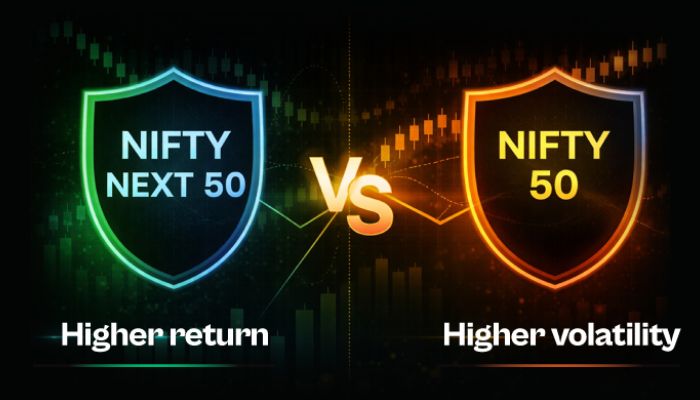
The Nifty 50 includes the "giants" of India like Reliance and HDFC Bank. These are very stable but grow slowly. The Nifty Next 50 has companies that are slightly smaller and can grow much faster. In bull markets, the Next 50 often gives much higher returns than the Nifty 50.
The Risk Factor
Higher returns come with higher risk. The Nifty Next 50 is more volatile. This means when the market falls, the Next 50 might fall more than the Nifty 50. However, for a long-term investor (5 to 10 years), the Next 50 has historically provided a better "wealth-building" experience.
Nifty Next 50 Index Fund vs ETF
Should you buy an Index Fund or an ETF? Both follow the same 50 stocks, but they work differently.
1. Trading Style
You buy ETFs on the stock exchange (like NSE or BSE) using a Demat account. You can buy them at any time during market hours. Index Funds are bought directly from the mutual fund company at the end-of-day price.
2. Costs
ETFs usually have lower fees (Expense Ratio) than Index Funds. However, you have to pay brokerage fees and DP charges when you buy or sell ETFs. If you are doing a small monthly SIP, an Index Fund might be simpler. If you are investing a large amount at once, an ETF is often cheaper.
3. ETF Liquidity in India
This is a very important point. In India, some ETFs do not have many buyers and sellers. This is called low liquidity. If an ETF has low liquidity, you might have to sell it at a lower price than its actual value. Always stick to the big ETFs like Junior BeES to avoid this problem.
Why Invest in Nifty Next 50 in 2026?

The Indian economy is growing fast. Many mid-sized companies are becoming world-class leaders. By 2026, the Nifty Next 50 has become a core part of many portfolios for these reasons:
-
Diversification: It gives you exposure to sectors that are not well-represented in the Nifty 50, like chemicals or niche manufacturing.
-
Automatic Selection: The index automatically removes weak companies and adds rising stars. You don't have to pick stocks yourself.
-
Lower Entry Cost: You can start investing in an ETF with just the price of one unit, which is usually very low (often under ₹1,000).
Taxation on Nifty Next 50 ETFs (2026 Rules)
As of 2026, the tax rules for equity investments in India are:
-
Short-Term Capital Gains (STCG): If you sell your ETF within 1 year, you pay 20% tax on the profit
-
Long-Term Capital Gains (LTCG): If you sell after 1 year, profits up to ₹1.25 Lakh in a year are tax-free. Any profit above this is taxed at 12.5%.
How to Start Investing?
To invest in the Best Nifty Next 50 ETF in India 2026, follow these simple steps:
- Open a Demat Account: You can use popular apps like Zerodha, Groww, or Upstox.
- Search for the ETF: Type the name (like "JUNIORBEES" or "NEXT50ETF") in the search bar.
- Check Liquidity: Look at the "Market Depth" to see if there are plenty of buyers and sellers.
- Place an Order: You can buy 1 unit or 1,000 units. It works just like buying a stock.
Summary Table: Top ETFs at a Glance
| ETF Name | Liquidity | Ideal For |
| Nippon Junior BeES | Very High | Large investments and easy exit. |
| Kotak Next 50 ETF | High | Investors looking for low fees. |
| UTI Next 50 ETF | Medium-High | Investors who want high accuracy. |
| ICICI Pru Next 50 | High | Reliable banking-backed fund. |
Conclusion
The Nifty Next 50 is a powerful tool for building wealth in India. While it is more volatile than the Nifty 50, its ability to capture the growth of future leaders is unmatched. In 2026, ETFs like Nippon Junior BeES and Kotak Next 50 remain the top choices due to their low costs and ease of trading.
If you have a long-term view and can handle small ups and downs in the market, adding a Nifty Next 50 ETF to your portfolio is a very smart move. Always check the liquidity before buying and stay invested for at least 5 years to see the best results.
FAQ
1. Which is the best Nifty Next 50 ETF in India 2026 for a beginner?
For a new person, the best Nifty Next 50 ETF in India 2026 is Nippon India ETF Nifty Next 50 Junior BeES. It has good trading volume. You can buy and sell easily. The cost is low. The fund house is old and trusted. If you cannot find that, ICICI Prudential Nifty Next 50 ETF is also a very good second choice.
2. What is the main difference in Nifty Next 50 vs Nifty 50 for returns?
In Nifty Next 50 vs Nifty 50, the main difference is risk and return. Nifty Next 50 gives higher returns over long time but falls more when market goes down. Nifty 50 is more stable. For example, in a good year, Next 50 may give 15 to 18 percent while Nifty 50 gives 10 to 12 percent. In a bad year, Next 50 may fall 12 percent while Nifty 50 falls 6 to 7 percent.
3. Between Nifty Next 50 index fund vs ETF, which one has lower cost?
In the comparison of Nifty Next 50 index fund vs ETF, the ETF always has lower cost. ETF expense ratio is around 0.2 to 0.4 percent. Index fund expense ratio is around 0.8 to 1.2 percent. Over many years, this small difference becomes a big amount. So ETF is better if you have a demat account.
4. How often do next 50 index constituents change?
The next 50 index constituents change every six months. NSE does this rebalancing in March and September. Some companies move up to Nifty 50. Some go down to smallcap. New rising companies enter the index. You do not have to do anything. Your ETF automatically adjusts to these changes.
5. Is ETF liquidity India a problem for Nifty Next 50 ETFs?
For the top two ETFs, ETF liquidity India is not a big problem. Junior BeES and ICICI Nifty Next 50 ETF have enough daily volume for normal investors. But for very large amounts above 5 to 7 lakh rupees, you should check the order book and use limit order. Do not use market order. For HDFC and Motilal Oswal ETFs, liquidity is lower. So stick with the top two for peace of mind